
LACCEI K-12: Engineering for the Americas Challenge
Informative video (Jan. 21, 2026): click here. Passcode: Q@#RoMC7
LACCEI K-12: Engineering for the Americas Challenge
The LACCEI K-12: Engineering for the Americas Challenge is an international competition that brings together diverse educational initiatives to showcase innovative projects that inspire and motivate pre-university (K-12) students to explore and consider careers in engineering. The competition highlights programs, activities, and actions that effectively bridge the gap between early education and opportunities in engineering, strengthen student motivation, and promote clear pathways toward engineering careers throughout the Americas.
What is K-12 in the Americas?
In the Americas, K-12 refers to the full range of education from Kindergarten through 12th grade, including:
- Elementary School (Educación básica)
- Middle School / Junior High School (Educación primaria)
- High School / Secondary School (secundaria, bachillerato, or preparatoria)
K-12 encompasses all pre-university students, and this competition recognizes initiatives that encourage them to discover engineering as a potential future career. All initiatives must be directed toward K-12 students, with the purpose of:
- Increasing interest in engineering
- Providing early exposure to engineering concepts, tools, and real-world challenges
- Demonstrating educational and career pathways in engineering
- Encouraging creativity, problem-solving, and hands-on engineering activities
- Strengthening connections between schools and engineering programs at universities
Target Audience (Who Can Participate)
This competition is intended for teams that develop engineering-focused educational initiatives for K-12 students, including:
- Elementary schools
- Middle schools
- High schools / secondary schools / colegios / preparatorias
- Universities and colleges with engineering outreach for K-12
- Faculty members or researchers conducting engineering education initiatives
- Engineering or technical clubs within an educational institution
Who Cannot Participate
- Private companies, corporations, or businesses
- Non-profit organizations not affiliated with an educational institution
- Individual applicants (teams only)
Eligibility (Participation Requirements)
These requirements determine who can participate; they are different from evaluation criteria.
- Teams must represent an educational institution:
- Elementary, middle, or high school
- College or university with engineering outreach programs
- Faculty or researchers leading engineering initiatives for K-12
- Engineering or technical clubs within an educational institution
- Each team must submit:
- A written summary (1–2 pages)
- A 3-minute video (MP4)
- Materials may be submitted in English, Portuguese or Spanish.
- Late submissions will not be accepted.
- At least one member of each finalist team must complete a paid registration for the LACCEI 2026 Multiconference in Chile.
- All team members attending the event in person must be formally registered.
Examples of types of Initiatives That Can Participate
For example, initiatives, proposals, or projects might be related to:
- Recruitment or retention of K-12 students into engineering
- Engineering-related leadership opportunities for young students
- Exposure to engineering ideas, processes, tools, or hands-on challenges
- Engineering-focused community activities that build capacity or interest
- Programs that connect schools with engineering faculties
- Efforts to promote access to engineering for underrepresented groups
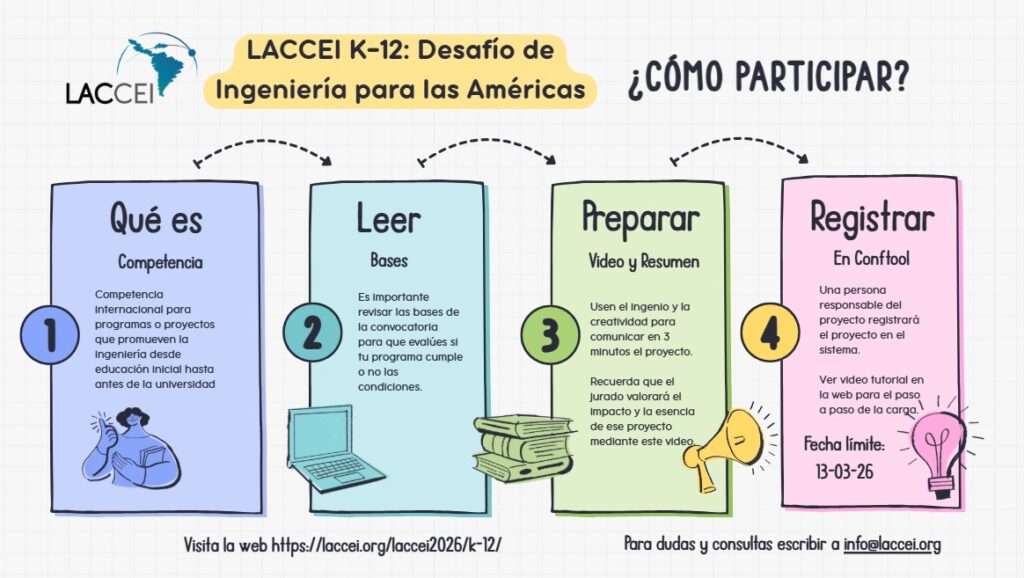
How to Participate – Step by Step
To recognize and support outstanding initiatives, prizes will be awarded to the top three teams (In Person):
- Register online at ConfTool.
- Video tutorial on how to log in to ConfTool and how to upload your proposal: https://youtu.be/DqhQ2xC7yAk
- Upload your submission via ConfTool: https://www.conftool.pro/laccei2026
- Written summary (1–2 pages)
- 3-minute engineering initiative video (MP4)
- Phase 1 Evaluation: Judges will review all entries and select the finalist teams.
- Registration for Finalists: At least one team member must register for LACCEI 2026 (Chile). All in-person presenters must complete formal registration.
- Final Presentation: Finalists will present their engineering initiatives during LACCEI 2026 in Chile.
- Awards Ceremony: Certificates and monetary awards will be given to the top teams.
Awards
Teams may submit their proposals either in the In-Person or Virtual modality. Participation in both modalities is not permitted, and no changes will be accepted after the proposal submission deadline has closed.
To recognize and support outstanding initiatives, prizes will be awarded to the top three teams (In Person):
- First Place: 2,500 USD.
- Second Place: 2,000 USD.
- Third Place: 1,000 USD.
The three best virtual projects will be recognized with the following awards:
- First place: 500 USD.
- Second place: Certificate only.
- Third place: Certificate only.
Timeline of the Competition
- October, 2025: Opening of registrations
- December, 2025: Attend the virtual info session & get your questions answered
March 13th, 2026: Submit your team’s video presentation & technical proposal- April 1, 2026 – New Deadline to submit your team’s video presentation & technical proposal LACCEI K-12 (pre-university level) Engineering Challenge (hybrid).
- April, 2026: Evaluation period by judges
- April 24th, 2026: Notification of finalists
- July, 2026: Present your work at the LACCEI conference in Chile
Evaluation Criteria
Objective: Ensure transparency and fairness in project evaluation. Projects will be evaluated based on:
- Innovation and Creativity: The initiative demonstrates originality, creativity, or innovative approaches to engage and inspire K-12 students toward engineering.
- 25%
- Impact and Outcomes: Evidence of measurable positive outcomes on students and the community (e.g., increased interest in engineering, student engagement, skills development).
- 25%
- Access and Equity: The initiative promotes diversity and equitable access to engineering opportunities for underrepresented groups.
- 15%
- Sustainability and Scalability: The project demonstrates potential for long-term sustainability or replication in other contexts or institutions.
- 15%
- Presentation and Clarity: The video and supporting materials clearly communicate the initiative’s objectives, methods, and outcomes.
- 10%
- Collaboration and Leadership: Evidence of teamwork, student leadership, and collaboration with schools, universities, or community organizations.
- 10%
https://laccei.org/LACCEI_uploads/K12-Evaluation_Criteria.pdf
Quick Q&A
1. Is this competition for student projects or for educational programs?
This competition is for educational initiatives or programs, not for individual projects. The focus is on programs K-12 that already exist or are currently being implemented, led by institutions, faculty, or organized teams.
2. Can universities or colleges submit initiatives to the competition?
Yes. Universities and colleges are encouraged to participate with initiatives focused on engineering education for K–12 students, including outreach programs, camps, hands-on workshops, mentoring, and pipeline initiatives.
3. Can future ideas or project proposals be submitted to the competition?
No. The competition does not evaluate future ideas or proposals. Initiatives should be already implemented or ongoing, with some evidence of impact or results.
4. Can one institution submit more than one initiative?
Yes. There is no limit on the number of initiatives an institution may submit, as long as each submission represents a distinct initiative.
6. What is more important: the video or the written summary?
Both are important and complementary.
- The video should clearly explain the initiative and its impact.
- The written summary provides structure, context, and supporting details.
7. Do initiatives need to be large-scale or have a significant budget to be considered?
No. Initiatives of any size are welcome. The competition emphasizes impact, creativity, and replicability rather than the scale or budget of the initiative.
8. Do all members of a finalist team need to register and present at the competition?
No. Only at least one representative per finalist team is required to register and present (in-person or virtually, depending on the modality selected).
Contact / Support
- ConfTool: Video & Technical proposal
- https://www.conftool.pro/laccei2026/
- Direct Link to the track: click here (ConfTool)
Coordinator / Contact
Dr. Homero Murzi. Texas A&M University (TAMU) – USA
hmurzi@tamu.edu
info@laccei.org