Organization of American States Summit for Hemispheric Engineering Education Alliances
Tuesday/Martes, 2 Dec. 2025
8 AM PST/10 AM PST/Central/11 AM – 1 PM (11:10 – 1:00) EST: Cartagena, Colombia – Hybrid
As engineering education evolves to meet the demands of an increasingly interconnected world, how do we build alliances that transcend borders, bridge diverse contexts, and prepare graduates to address society’s most pressing challenges? This summit brings together perspectives from across the hemisphere to explore critical themes shaping the future of engineering education in the Americas.
This session employs an innovative format that amplifies voices from across the global engineering education community. For each focus area, distinguished engineering education leaders have provided written insights in response to an overarching question. Their responses—displayed alongside their profiles—serve as provocations that launch our facilitated conversation among track leads. This format creates a layered dialogue that honors the diversity of engineering education contexts across the Americas while identifying common ground and collaborative pathways forward.
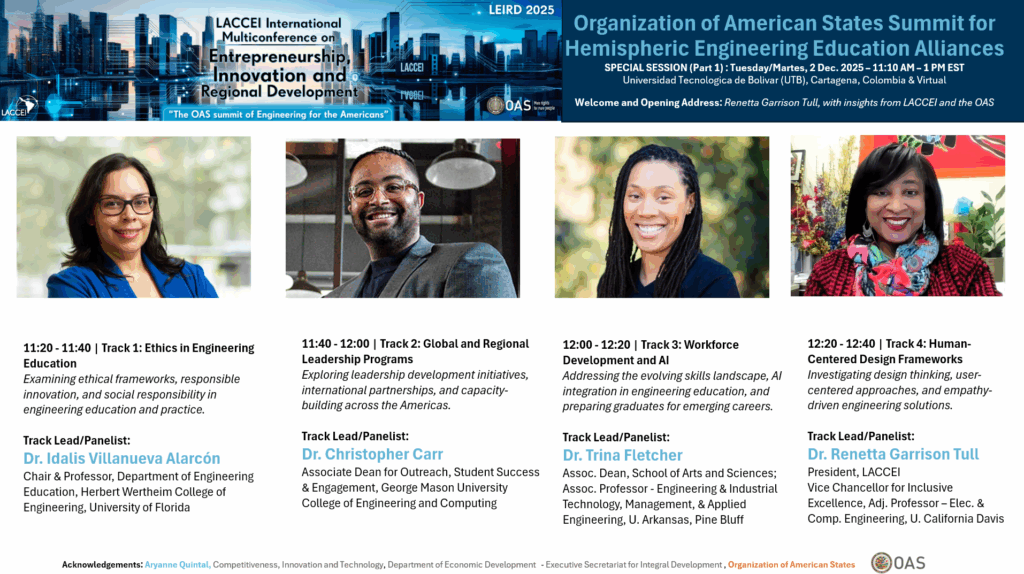
Track Leaders
Tracks
Watch the live stream on YouTube:

https://www.youtube.com/@lacceiofficial/streams
Agenda
As engineering education evolves to meet the demands of an increasingly interconnected world, how do we build alliances that transcend borders, bridge diverse contexts, and prepare graduates to address society’s most pressing challenges? This summit brings together perspectives from across the hemisphere to explore critical themes shaping the future of engineering education in the Americas.
This session employs an innovative format that amplifies voices from across the global engineering education community. For each focus area, distinguished engineering education leaders have provided written insights in response to an overarching question. Their responses—displayed alongside their profiles—serve as provocations that launch our facilitated conversation among track leads. This format creates a layered dialogue that honors the diversity of engineering education contexts across the Americas while identifying common ground and collaborative pathways forward.
11:10 – 11:20 | Welcome & Opening Remark
Welcome: Dr. Renetta Garrison Tull, President, LACCEI; Vice Chancellor for Inclusive Excellence, UC Davis
Acknowledgement: Aryanne Quintal, Organization of American States (OAS), Executive Secretariat for Integral Development (SEDI)
11:20 – 11:40 | Track 1: Ethics in Engineering Education
Examining ethical frameworks, responsible innovation, and social responsibility in engineering education and practice.
Track Lead/Panelist: Dr. Idalis Villanueva Alarcón, Chair & Professor, Engineering Education, University of Florida
Overarching Question: As AI and emerging technologies accelerate faster than policy can respond, how do we embed ethical reasoning and social responsibility into engineering education so that graduates instinctively consider the societal implications of their innovations—not as an afterthought, but as foundational to their practice?
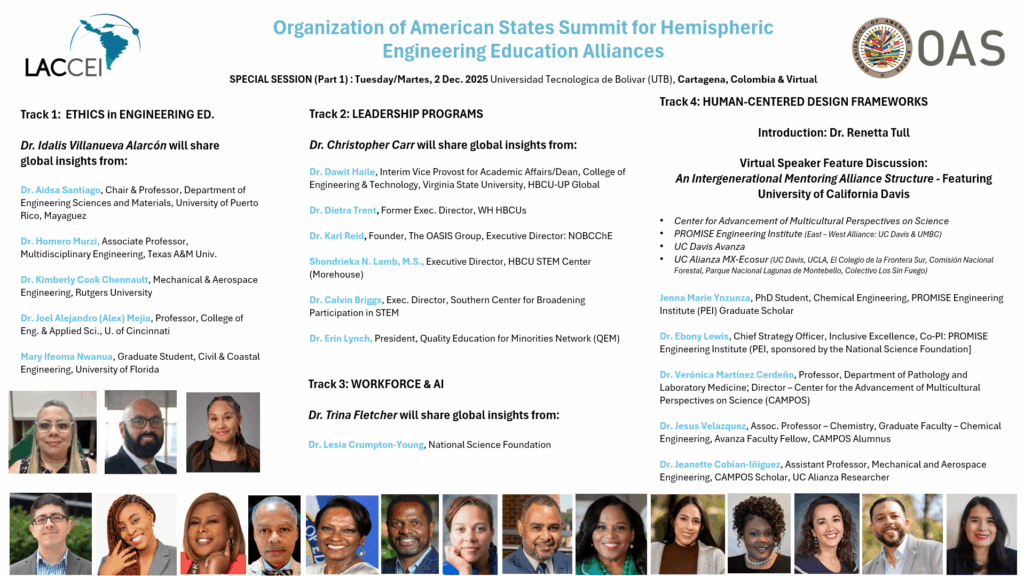
Global Insights From:
- Dr. Aidsa Santiago, Chair & Professor, Department of Engineering Sciences and Materials, University of Puerto Rico, Mayaguez
- Dr. Homero Murzi, Associate Professor, Multidisciplinary Engineering, Texas A&M University
- Dr. Kimberly Cook Chennault, Mechanical & Aerospace Engineering, Rutgers University
- Dr. Joel Alejandro (Alex) Mejia, Professor, College of Eng. & App. Sci., U. of Cincinnati
- Mary Ifeoma Nwanua, Graduate Student, Civil & Coastal Engineering, University of Florida
11:40 – 12:00 | Track 2: Global and Regional Leadership Programs
Exploring leadership development initiatives, international partnerships, and capacity-building across the Americas.
Track Lead/Panelist: Dr. Christopher Carr, Associate Dean for Outreach, Student Success & Engagement, George Mason University College of Engineering and Computing
Overarching Question: Given that engineering innovations solving the world’s most pressing problems are happening across the hemisphere—not just in traditional Western centers—how do we build leadership development programs that position students to learn FROM global partners rather than simply exporting Western models, and what institutional structures make these reciprocal partnerships sustainable?
Global Insights From:
- Dr. Dawit Haile, Interim Vice Provost for Academic Affairs/Dean, College of Engineering & Technology, Virginia State University, HBCU-UP Global
- Dr. Dietra Trent, Former Exec. Director, WH HBCUs, Former VP & CDO, GMU, Former Sec. of Education, State of VA
- Dr. Karl Reid, CDP, Founder, The OASIS Group, Executive Director: NOBCChE, Former VP & CIO, M.I.T., Former Exec. Director, NSBE, Former Vice President, UNCF
- Shondrieka N. Lamb, M.S., Executive Director, HBCU STEM Center (Morehouse), Former Director, Identity Res. Center (Morehouse), Former Director, Race to the Top (Morehouse)
- Dr. Calvin Briggs, Executive Director, Southern Center for Broadening Participation in STEM, Former Director, Center for STEM Excellence, Team Member, AAAS-IUSE
- Dr. Erin Lynch, CRA, President, Quality Education for Minorities Network (QEM)
- Former Executive Director- Innovation, Winston-Salem State University, Former Research Director, TN State
12:00 – 12:20 | Track 3: Workforce Development and AI
Addressing the evolving skills landscape, AI integration in engineering education, and preparing graduates for emerging careers.
Track Lead/Panelist: Dr. Trina Fletcher, Associate Dean, School of Arts and Sciences; Associate Professor of Engineering and Industrial Technology, Management, and Applied Engineering, University of Arkansas, Pine Bluff
Overarching Question: As AI transforms the engineering workforce faster than curricula can adapt, how do we prepare students not just to use AI tools, but to critically evaluate their limitations, advocate for equitable implementation, and ensure that workforce development initiatives reach historically underserved communities across the hemisphere?
Global Insights From:
- Dr. Lesia Crumpton-Young, National Science Foundation
12:20 – 12:40 | Track 4: Human-Centered Design Frameworks
Investigating design thinking, user-centered approaches, and empathy-driven engineering solutions.
Track Lead/Panelist: Dr. Renetta Garrison Tull, President, LACCEI; Vice Chancellor for Inclusive Excellence, UC Davis
Overarching Question: How do we move beyond tokenistic “community input” toward genuine co-design partnerships where the communities most impacted by engineering solutions hold decision-making power in the design process—and what does this mean for how we train the next generation of engineers to center human dignity in their practice?
Networking Spotlight: Connecting the Engineering Archimedean Oath, Community Principles and Frameworks, and Intergenerational Research Mentoring
Discussion: An Intergenerational Mentoring Alliance Structure
Featuring University of California Davis
- Center for Advancement of Multicultural Perspectives on Science
- PROMISE Engineering Institute (East – West Alliance)
- UC Davis Avanza
- UC Alianza MX-Ecosur
Speakers:
- Jenna Marie Ynzunza, PhD Student, Chemical Engineering, PROMISE Engineering Institute (PEI) Graduate Scholar
- Dr. Ebony Lewis, Chief Strategy Officer, Inclusive Excellence, Co-PI: PROMISE Engineering Institute (PEI) [NSF]
- Dr. Verónica Martínez Cerdeño, Professor, Department of Pathology and Laboratory Medicine; Director – Center for the Advancement of Multicultural Perspectives on Science (CAMPOS)
- Dr. Jesus Velazquez, Assoc. Professor – Chemistry, Graduate Faculty – Chemical Engineering, Avanza Faculty Fellow, CAMPOS Alumnus
- Dr. Jeanette Cobian-Iñiguez, Assistant Professor, Mechanical and Aerospace Engineering, CAMPOS Scholar, UC Alianza Researcher
12:45 Roundtable Discussion & Audience Engagement
Following all four tracks, panelists and session participants will engage in collaborative dialogue addressing:
- What structural barriers prevent sustainable hemispheric partnerships, and how do we dismantle them?
- How do we ensure that alliance-building centers equity and reciprocity rather than replicating colonial patterns of knowledge exchange?
- What concrete commitments can we make today to advance hemispheric engineering education collaboration?
Session Outcomes:
Attendees will leave with:
- Deeper understanding of hemispheric priorities in engineering education
- Concrete strategies for building cross-border alliances
- Connections to a growing network of educators committed to transforming how we prepare global engineering leaders
- Actionable next steps for advancing collaboration within their own institutions
JOIN US FOR SESSION II: Santiago Chile, Weds. July 15, 2026. The summit will be part of the 24th LACCEI International Multi-Conference for Engineering, Education and Technology: “Engineering without Borders: Artificial Intelligence, Knowledge, Innovation, and Alliances for a Future from the Americas.”